The Scholar’s Lantern
In a quiet corner of a bustling Ly Dynasty village in Vietnam, long after the last street vendor had packed away their wares and the communal fires had dwindled to embers, a singular light persisted. It emanated from the modest dwelling of Le Van, a scholar whose days were spent teaching the village children and advising the local magistrate, but whose nights belonged entirely to the pursuit of knowledge. Unlike the farmers who sought repose after their toil, Le Van found his greatest clarity and dedication under the cloak of darkness, shielded from the distractions of daylight. His small study, barely more than an alcove in his bamboo-and-thatch home, was a sanctuary of scrolls, brushes, inkstones, and ancient texts.
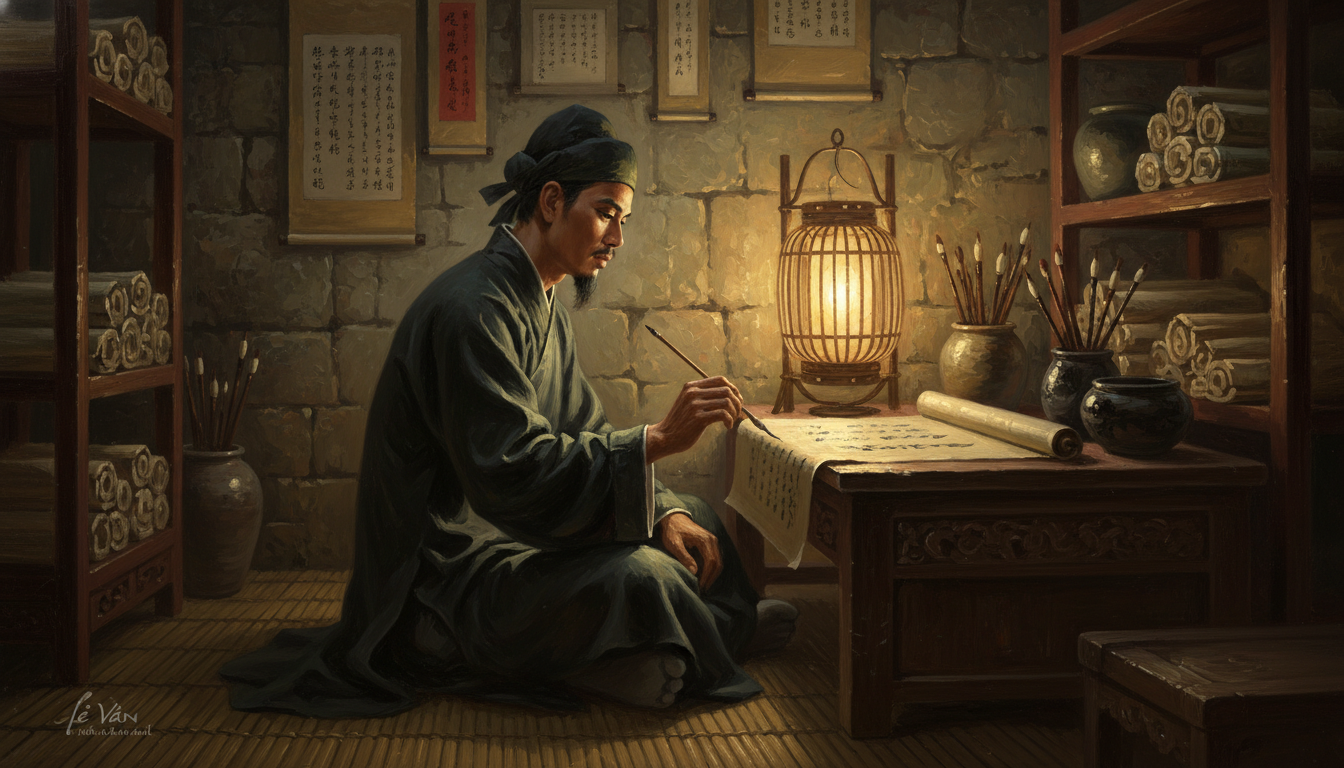
Le Van, a man in his late forties with a wispy beard and eyes that held a permanent twinkle of intellectual curiosity, sat cross-legged on a woven mat. Before him, a bamboo lantern, fueled by carefully refined plant oil, cast a warm, steady glow upon an open scroll. Tonight, he meticulously copied passages from the ‘Dai Viet Su Ky Toan Thu,’ the complete historical records of Dai Viet, a monumental task that demanded absolute concentration and reverence for the written word. The scrape of his brush against the delicate rice paper was the only sound, a rhythmic symphony of intellectual labor. Each character, formed with exquisite precision, was a testament to his dedication, a small act of preserving the collective memory of his people.
Psychologically, Le Van’s nocturnal scholarship was driven by a deep-seated thirst for understanding and a profound sense of duty. He was not just a copyist; he was an interpreter, a guardian of knowledge in an era where books were rare and literacy a privilege. He believed that the wisdom of the ancients held the keys to societal harmony and personal enlightenment. The quiet of the night amplified his thoughts, allowing him to delve deeper into the philosophical nuances of Confucian teachings or the strategic intricacies of ancient military campaigns. He often felt a profound connection to the scholars who had penned these words centuries before, a shared camaraderie across time and space, united by the persistent glow of a scholar’s lamp.
Occasionally, his wife, Hoa, a woman of practical wisdom and quiet strength, would stir from her sleep in the adjoining room. She would often rise to offer him a small bowl of warmed tea, her presence a silent act of support and understanding. ‘Van, your eyes will tire,’ she might whisper, her voice soft with concern. He would offer a grateful smile. ‘A few more lines, Hoa. The ancestors speak to me tonight.’ Her understanding was crucial; she knew that his work, though not yielding immediate material wealth, was vital for the spiritual and intellectual well-being of their family and the wider community. His insights, born from these solitary hours of study, would often inform his advice to the magistrate, shaping local policy and dispute resolution.
The hours passed in this focused contemplation. The distant calls of night birds, the occasional rustle of leaves, all faded into the background as Le Van immersed himself in the world of texts. He knew that the knowledge he absorbed and preserved was a torch, passed from generation to generation, illuminating the path forward.
As the first faint streaks of grey began to appear on the horizon, signaling the approach of dawn, Le Van would carefully roll up his finished scroll, clean his brush and inkstone, and extinguish his lantern. His eyes, though weary, would shine with the quiet satisfaction of a night well spent, knowing that he had contributed another small, vital piece to the grand mosaic of human understanding. This quiet, persistent pursuit of learning by moonlight was a cornerstone of intellectual life in ancient Asian villages, often unseen but profoundly impactful.