Healing Herbs by Moonlight
Under the serene, silvery glow of a Gupta Empire moon, the world outside the small Indian village of Nalanda seemed to hush, yet within one humble dwelling, a focused intensity permeated the air. Here, in a small, meticulously organized room, lived Vaidya Devi, the village’s esteemed healer. Her knowledge of Ayurvedic medicine, passed down through a long lineage of healers, was a beacon of hope for a community constantly battling illness and ailments. Tonight, Devi was engaged in a particularly delicate task: preparing potent herbal remedies, a process she believed was greatly enhanced by the cool, potent energy of the moon.
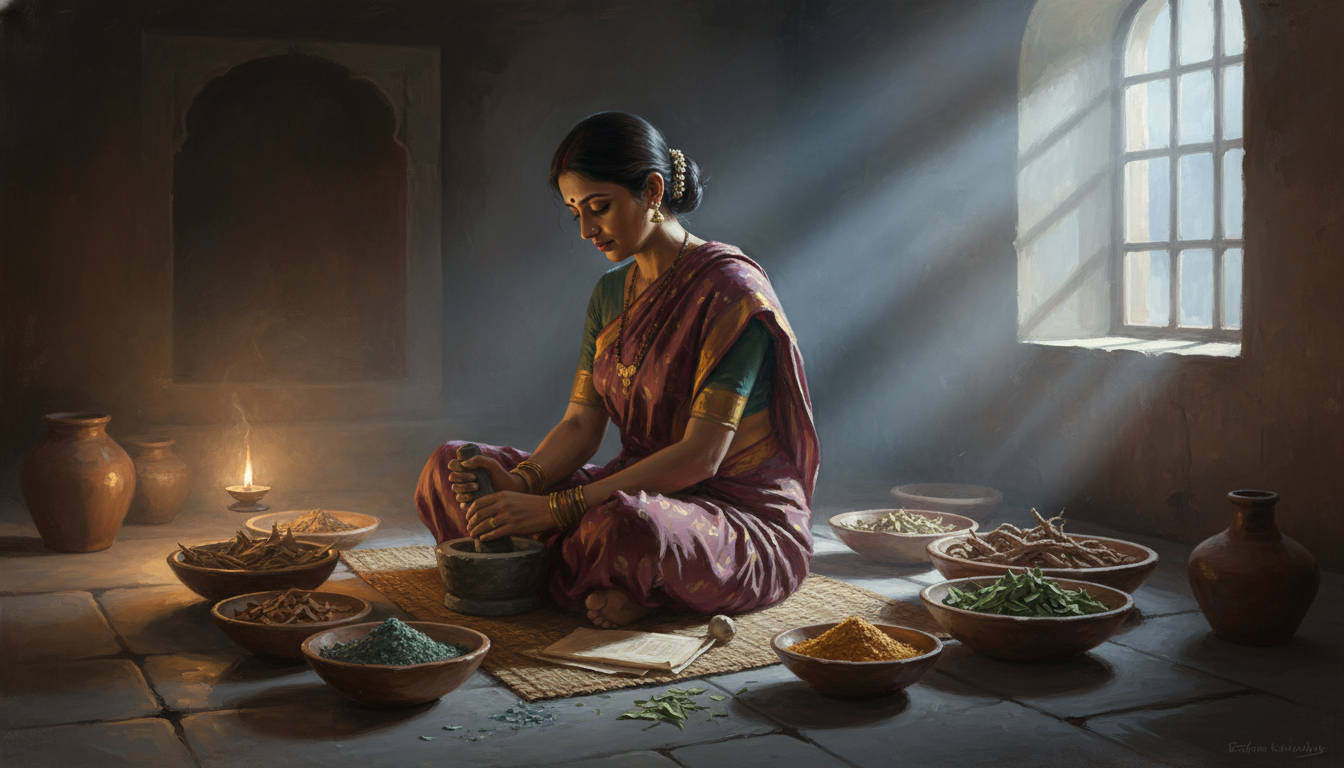
Devi, a woman whose calm demeanor belied a formidable intellect and an encyclopedic knowledge of botany, sat cross-legged on a woven mat. Before her, a collection of clay bowls held various dried leaves, roots, barks, and powdered minerals. A small, carefully trimmed wick lamp provided a soft, steady glow, supplementing the moonlight that streamed through an open window, bathing the room in an ethereal luminescence. The air was filled with the pungent, earthy aromas of a hundred different herbs, each with its own story, its own curative property.
Tonight, she was grinding a specific blend of Ashwagandha root and Brahmi leaves, known for their calming and restorative properties, for a villager suffering from ‘vata’ imbalance, a condition manifesting as anxiety and sleeplessness. Her movements were precise, almost ritualistic. She used a small stone mortar and pestle, her wrists moving with a rhythmic, grinding motion that was both powerful and gentle.
‘The moon’s light,’ she would often explain to her apprentices, ‘draws out the subtle essences, enhancing the potency of the herbs. It is a cooler, calmer energy, perfect for healing the mind and spirit.’ This belief in lunar influence on medicinal plants was not merely superstition; it was a deeply ingrained aspect of ancient Ayurvedic philosophy, connecting the micro-world of healing with the macro-cosmos. Psychologically, this belief also instilled a profound sense of reverence for nature, emphasizing a holistic approach to health.
As she worked, Devi often hummed a soft, melodic chant, a mantra for well-being that was as much a part of the remedy as the herbs themselves. Her focus was absolute, each grain of powder, each drop of oil, treated with utmost respect. She was not merely mixing ingredients; she was channeling ancient wisdom, invoking the healing power of the earth and the heavens.
Occasionally, her elderly sister, who often assisted her, would bring a cup of warm spiced milk. ‘You work too late, Devi,’ she might gently chide. Devi would offer a tired but content smile. ‘The ailments do not sleep, sister. Nor can the healer.’ This exchange underscored the relentless demand on her skills, a constant battle against disease in a world without modern medicine.
The quiet solitude of the night was Devi’s laboratory and sanctuary. Free from the day’s interruptions and the pleas of her patients, she could delve into the intricate art of compounding, experimenting with ratios, and perfecting ancient recipes. She might also review her extensive collection of palm-leaf manuscripts, studying new combinations or revisiting classic formulations.
As the moon began its slow descent, signaling the approach of dawn, Devi would carefully seal her newly prepared concoctions in small clay jars, each labeled with intricate Sanskrit calligraphy. Her work complete, she would extinguish her lamp, allowing the cool morning air to replace the herbal aromas. She rested, knowing that the remedies crafted under the moon’s watchful eye would soon bring relief and restoration to those who sought her ancient wisdom, a testament to the silent, tireless dedication of the ancient healers.