Amidst Shadows: The Birth Chamber

The first pangs had begun in the dead of night, a dull ache that grew in intensity until it seized Elara’s entire being. It was the winter of 1350, just before the deepest freeze. Thomas, roused by her gasps, had hurried to fetch Agnes, who arrived moments later, her face grim with purpose. The small, carefully prepared birthing chamber, usually a quiet corner, now vibrated with a palpable tension. A flickering tallow candle cast dancing shadows on the mud-plastered walls, making the room seem both intimate and vast, a stage for a primal drama. The air was thick with the scent of burning herbs, meant to purify and protect, mixed with the rising smell of sweat and effort.
Agnes, her experienced hands surprisingly gentle yet firm, helped Elara out of her kirtle, replacing it with a loose linen shift. “Breathe, child,” she instructed, her voice low and steady, a calming counterpoint to Elara’s increasingly ragged cries. “Breathe deep from your belly. You are strong. Your mother was strong. Your grandmother was strong.” Elara clutched at the rough blanket, her knuckles white. Each contraction was a wave, engulfing her, dragging her down into a sea of pain, then receding just enough to allow a gasp of air, a moment of respite before the next assault.
Soon, other women from the village arrived, summoned by Agnes’s earlier cries. Old Maude, with her knowing eyes, and Beatrice, who hovered with a mixture of sympathy and fear, remembering her own ordeal. They formed a silent circle around Elara, their presence a collective strength. One woman chafed Elara’s cold feet, another moistened her dry lips with a damp cloth, while a third whispered prayers to the Virgin Mary and Saint Margaret, patroness of childbirth, her voice a low, melodic drone. There were no male relatives allowed, save perhaps a priest at the very end, if the situation became dire. This was women’s work, a sacred, perilous rite passed down through generations.
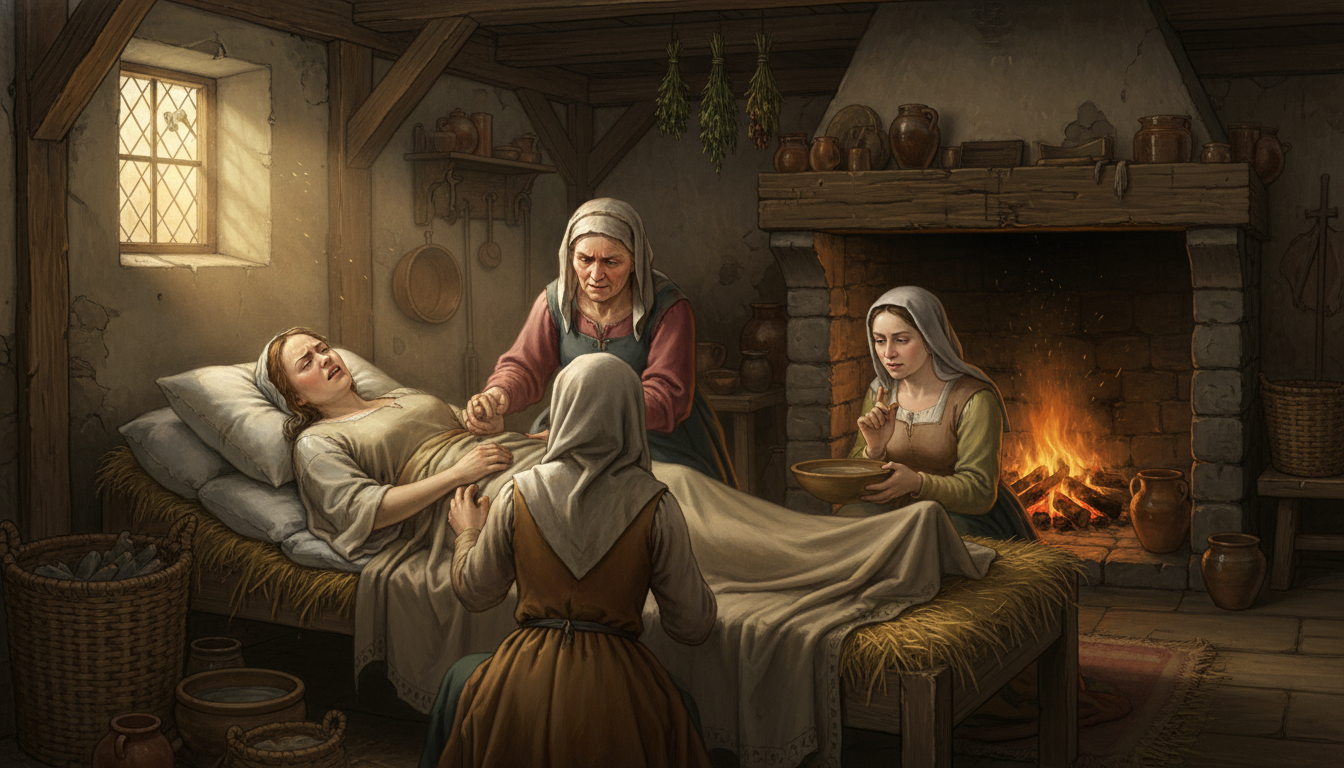
Hours bled into one another. The candle guttered lower, and the first hints of dawn seeped through the cracks in the walls, painting the room in shades of grey. Elara was exhausted, her body trembling with effort, her voice reduced to a hoarse moan. “I cannot,” she choked, tears mingling with sweat on her face. Agnes leaned close, her voice unwavering. “You can, Elara. The babe is coming. I see its crown.” The words, though terrifying in their implication, sparked a new resolve in Elara. She pushed, gritted her teeth against the searing pain, her body straining with every fiber of its being. The women chanted encouragement, their voices rising with hers, a primal chorus of support.
Suddenly, a shift. A final, monumental push, a tearing sensation, and then, a slippery warmth, followed by a thin, reedy cry that pierced the heavy silence. A baby’s cry. A new life. The sound was the most beautiful Elara had ever heard, washing away the agony, replacing it with an overwhelming wave of relief and awe. Agnes, with practiced ease, held up the tiny, crimson-skinned infant, its wrinkled face scrunched in protest at its sudden entry into the cold world. “A boy, Elara! A fine, healthy boy!” she announced, her voice filled with triumph.
Elara collapsed back onto the bed, utterly spent, but a weak smile touched her lips as she gazed at the miracle squalling in Agnes’s arms. The other women murmured thanksgivings, some wiping tears from their own eyes. The tension in the room began to dissipate, replaced by a quiet hum of wonder. Agnes swiftly attended to the afterbirth, ensuring it was expelled fully, a crucial step for the mother’s survival. Then, she gently cleaned the babe, checking its tiny limbs, its breathing. She cut the umbilical cord with a sterilized knife and tied it off with a linen thread, a ritual performed countless times before. The world outside the cottage might be harsh and unforgiving, but in this small, candlelit chamber, a new life had emerged, nurtured by the strength and collective wisdom of medieval womanhood, a testament to enduring hope amidst the ever-present shadows of mortality. Elara, though weak, felt a surge of fierce, protective love, a bond forged in pain and now solidified in the soft, rhythmic cries of her newborn son. The journey had been arduous, but the reward was immeasurable.