Giggles and Growths: Playtime and Stimulation
By the year 1480, Thomas John was no longer a perpetually swaddled infant but a bright-eyed, curious baby, approaching his first year. While the primary focus of medieval infant care was survival, the importance of play and interaction, though less explicitly codified than feeding or swaddling, was implicitly understood and deeply integrated into daily life. For Elara, these moments of playful engagement were not just diversions; they were essential for her son’s development, fostering joy, communication, and a growing understanding of his world.
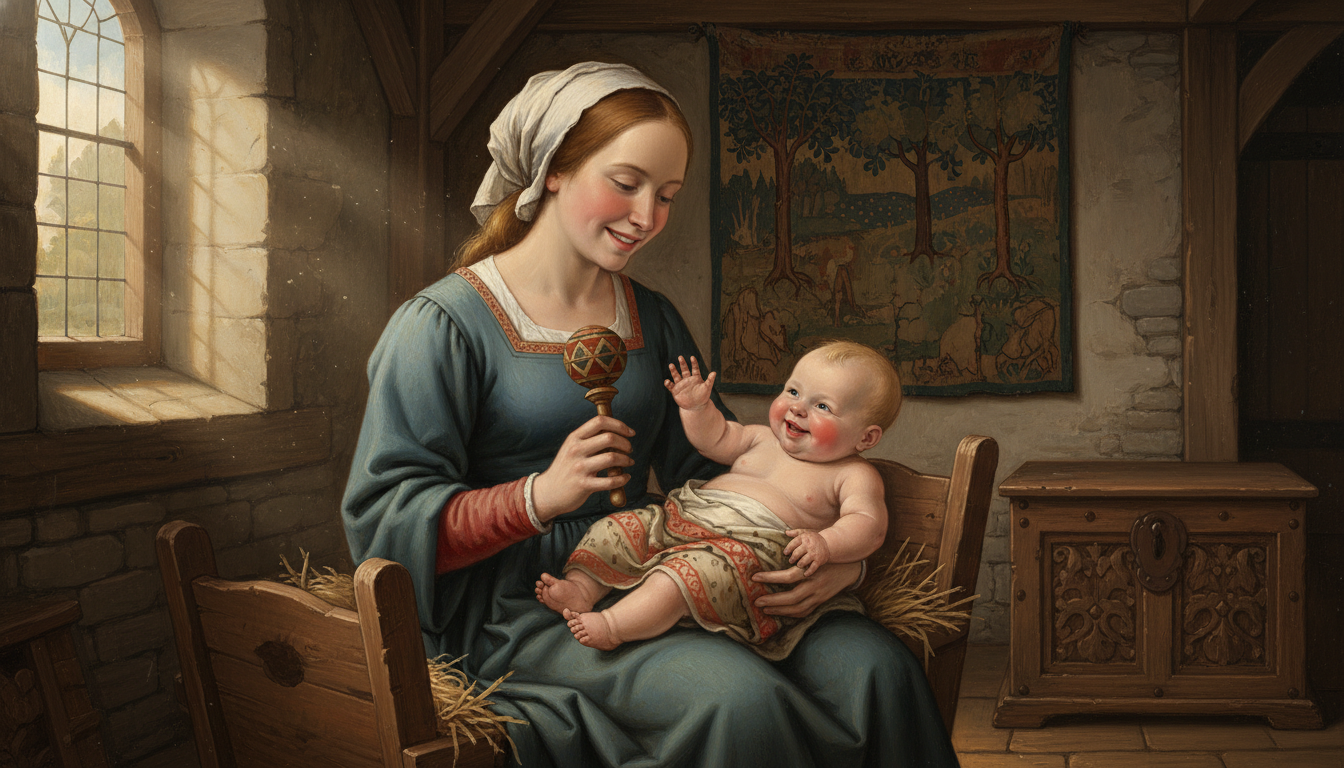
Formal toys, as we know them today, were scarce and often homemade. Thomas John’s first toys were simple, sensory objects. A small, wooden rattle, perhaps containing dried beans or pebbles, provided a captivating sound. Thomas, his father, had carved it with rudimentary skill, smoothing the edges and drilling holes for the tiny clatterers within. Elara would shake it gently, its soft rustle drawing Thomas John’s gaze, his eyes widening with fascination. She might dangle a string of polished river stones or bright berries (carefully supervised, of course), encouraging him to reach out and grasp, honing his developing motor skills. A rag doll, stuffed with straw and dressed in scraps of fabric, often served as a comforting companion and object for early imaginative play.
But true play extended far beyond objects. The most vital form of stimulation came from direct human interaction. Elara, despite her demanding schedule, dedicated moments throughout the day to engage with her son. She would hold him close, gently tickling his belly, eliciting delighted gurgles and wide, toothless smiles. “Peek-a-boo!” she would exclaim, covering her face with her hands and then revealing it, a simple game that brought endless joy and reinforced object permanence. Her voice, soft and melodious, was a constant source of comfort and learning. She would sing lullabies, tell simple stories about animals or the saints, and point out objects around the cottage, naming them in clear, repetitive tones. “Fire,” she might say, pointing to the hearth, or “Water,” gesturing to the pail. These early linguistic exposures, though informal, were crucial for his burgeoning language development.
Older siblings also played a significant role in a baby’s early play life. Thomas John had an older sister, Mary, who, despite her own chores, would often sit by the cradle, cooing at her baby brother, making funny faces, or gently jiggling his feet. Their interactions, though sometimes clumsy, provided valuable social stimulation and exposed him to different voices and temperaments within the family unit. The sounds of family life – laughter, conversation, the rhythmic thud of a loom, the clatter of tools – formed a rich auditory tapestry that stimulated his developing senses.
As Thomas John grew stronger and began to sit unsupported, his world expanded. He would sit on the cottage floor, perhaps on a straw mat, exploring the textures of the rushes, attempting to grasp the tail of a passing cat, or trying to put everything within reach into his mouth – a natural, if sometimes risky, stage of oral exploration. Elara watched him keenly, intervening when necessary, but mostly allowing him to investigate his immediate environment, ensuring it was as safe as possible from sharp objects or open flames.
These seemingly small moments of play and interaction were profoundly significant. They were the building blocks of cognitive, emotional, and social development, fostering a secure attachment to his mother and family, encouraging curiosity, and preparing him for the complex world beyond the cottage door. In the quiet giggles and curious glances, in the gentle touches and murmured words, Elara was not just caring for her baby; she was nurturing a future, cultivating a resilient spirit, and building a foundation of love and engagement that would define Thomas John’s journey from infancy into the demanding realities of medieval life. The echoes of his laughter were a testament to life’s simple joys, even in the most challenging of times.