The Fishermen’s Lanterns
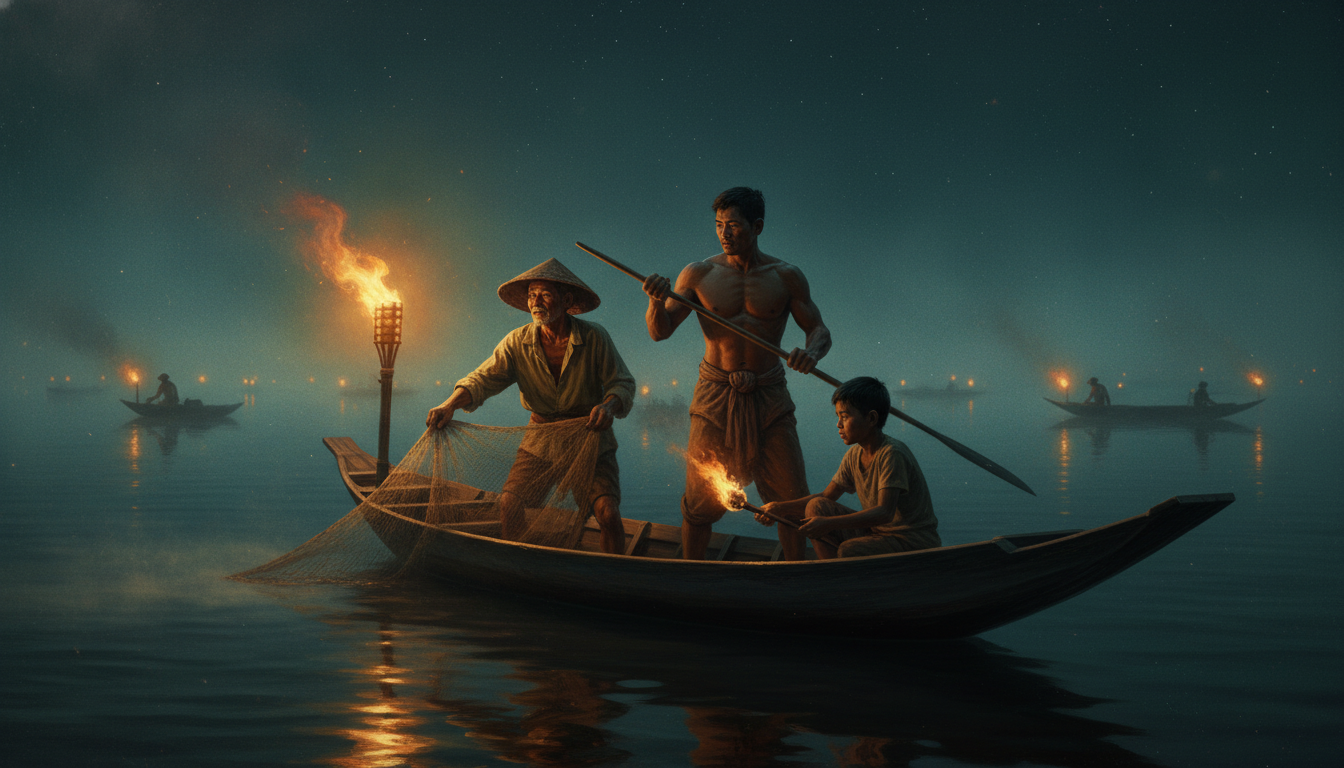
On the tranquil expanse of the Tonlé Sap lake, a vital artery of the Khmer Empire, as twilight faded into an inky blackness, a different kind of village awoke. This was not a village of fixed dwellings, but a floating community of fishermen, their lives intimately entwined with the ebb and flow of the waters. Tonight, like countless nights before, the call of the lake was strong. Three figures—the seasoned elder, Old Man Sopheak, his stalwart son, Sokha, and the young, eager grandson, Dara—prepared their long, narrow fishing boat, a ‘rua,’ for the night’s endeavor. The air was thick with the scent of water, mud, and dried fish, punctuated by the occasional croak of a bullfrog. Their equipment was simple but effective: nets carefully mended during the day, bamboo poles, and most importantly, large, flaming torches crafted from resinous wood and bound with palm fibers. These torches, once lit, would serve as both beacons and attractants for the fish.
Sokha, his strong arms rippling with muscle, carefully lit the first torch, its flame spitting and crackling, casting a vibrant, dancing light across the water’s surface. ‘Hold steady, Dara,’ he instructed, as the young boy, barely ten, cautiously helped secure the torch to the boat’s bow. Dara’s eyes, wide with a mixture of excitement and solemn responsibility, reflected the torch’s glow. This was his apprenticeship, a rite of passage into the arduous but rewarding life of a fisherman.
As they pushed off from their floating home, the ‘rua’ glided silently across the dark water, propelled by Sokha’s rhythmic paddling. Other similar boats, their own torches now blazing, dotted the distant horizon, a constellation of moving stars on the black canvas of the lake. The shared effort, the quiet camaraderie amongst these nocturnal laborers, was palpable. There was no need for extensive dialogue; their movements were synchronized, their understanding unspoken. Old Man Sopheak, seated at the stern, deftly handled the rudder, guiding them to familiar, productive fishing grounds. His gaze, however, was not fixed on the water, but upwards, towards the star-filled sky, reading the ancient signs that foretold weather and fortune.
The psychological landscape of night fishing was unique. It required immense patience, an intimate knowledge of the lake’s moods, and a stoic acceptance of uncertainty. There were nights of bountiful catches, and nights when the nets came up empty. Each cast of the net was a hopeful gamble against the vastness of nature. Dara, initially captivated by the flickering torchlight and the mystery of the deep, soon learned the quiet discipline required. He watched his father’s powerful movements, the graceful arc of the net as it unfurled, and his grandfather’s serene patience. He felt the cold spray of the water, the dampness in the air, the rhythmic pull of the paddle—all sensations etching themselves into his memory, forging his identity.
‘The moon will be full soon,’ Sopheak murmured, his voice a soft rasp against the gentle lapping of water. ‘The fish will be wary then.’
Sokha grunted in agreement. This was more than just a comment; it was a sharing of ancestral wisdom, a passing down of ecological knowledge crucial for their survival. As the hours passed, the torches illuminated the water, revealing the silvery flashes of fish drawn to the light. The nets were hauled in, heavy with their shimmering bounty, a testament to their efforts. The quiet celebration was in the full baskets, the shared exhaustion, and the silent promise of a meal for their families.
By the time the eastern sky began to lighten, and the first bird calls heralded the approaching dawn, the fishermen’s lanterns, now dimmer, began their slow journey back to their floating village, leaving behind a wake of shimmering silver scales and the quiet pride of a night’s honest labor, ready for the cycle to begin anew.