The Evening Bell and the Scent of Dinner
As the sun dipped below the distant, undulating hills, painting the sky in fiery hues of orange and deep crimson, a profound shift began to settle over the small Han Dynasty village of ‘Liangzhou.’ The air, once bustling with the cacophony of daytime labor—the rhythmic thud of a blacksmith’s hammer, the distant bleating of goats, the chatter of merchants in the nascent market square—began to soften.
The most distinctive sound marking this transition was the deep, resonant ‘GONG!’ of the village elder, Master Wei, striking the ancient bronze bell suspended near the central ancestral temple. Its vibrations rippled through the valley, a solemn yet comforting announcement, signaling the end of the agricultural workday and the call to hearth and home. Children, who moments before had been chasing geese through fallow fields or splashing in the shallow stream, immediately paused, their laughter giving way to a shared, almost instinctive understanding. ‘Xiaofeng! Ling’er! To the house, now!’ called a mother, her voice firm but tinged with the weary anticipation of rest. The little figures, dusty and invigorated, scurried towards their thatched-roof dwellings, a medley of excited whispers and shuffling feet.
The scent that began to dominate the twilight air was a complex tapestry of simmering rice, roasted vegetables, and the faint, savory aroma of cured pork or freshwater fish, if the day’s catch had been bountiful. Each household’s humble dinner preparations contributed to this communal fragrance, a silent testament to the evening ritual. Inside the packed earth homes, oil lamps were carefully lit, casting flickering, amber glows that chased away the encroaching shadows. The small, clay-fired lamps, often fueled by vegetable oils, offered meager illumination, but it was enough to bring faces into soft focus around a low table.
Families, often multi-generational, would gather. Old Grandmother Li, her back slightly stooped from decades in the rice paddies, would meticulously arrange bowls of steamed millet, pickled mustard greens, and perhaps a small dish of fermented tofu. Her gnarled hands moved with a practiced grace born of repetition. Young Chen, no more than seven years old, would sit cross-legged, his eyes wide with hunger, but patiently awaiting his turn. His father, a farmer named Bao, would enter, his calloused hands washed in a basin outside, his face etched with the day’s toil. He offered a respectful nod to his elders before taking his place.
Dialogue would be sparse but significant. ‘Bao, the fields fared well today?’ Grandmother Li might inquire, her voice raspy. Bao would respond, ‘The spring rains were good, Mother. The wheat promises a hearty yield.’ Such exchanges were not merely informational; they were affirmations of continuity, of the land’s benevolence, and the family’s shared fate. There was an unspoken understanding, a quiet strength that underpi
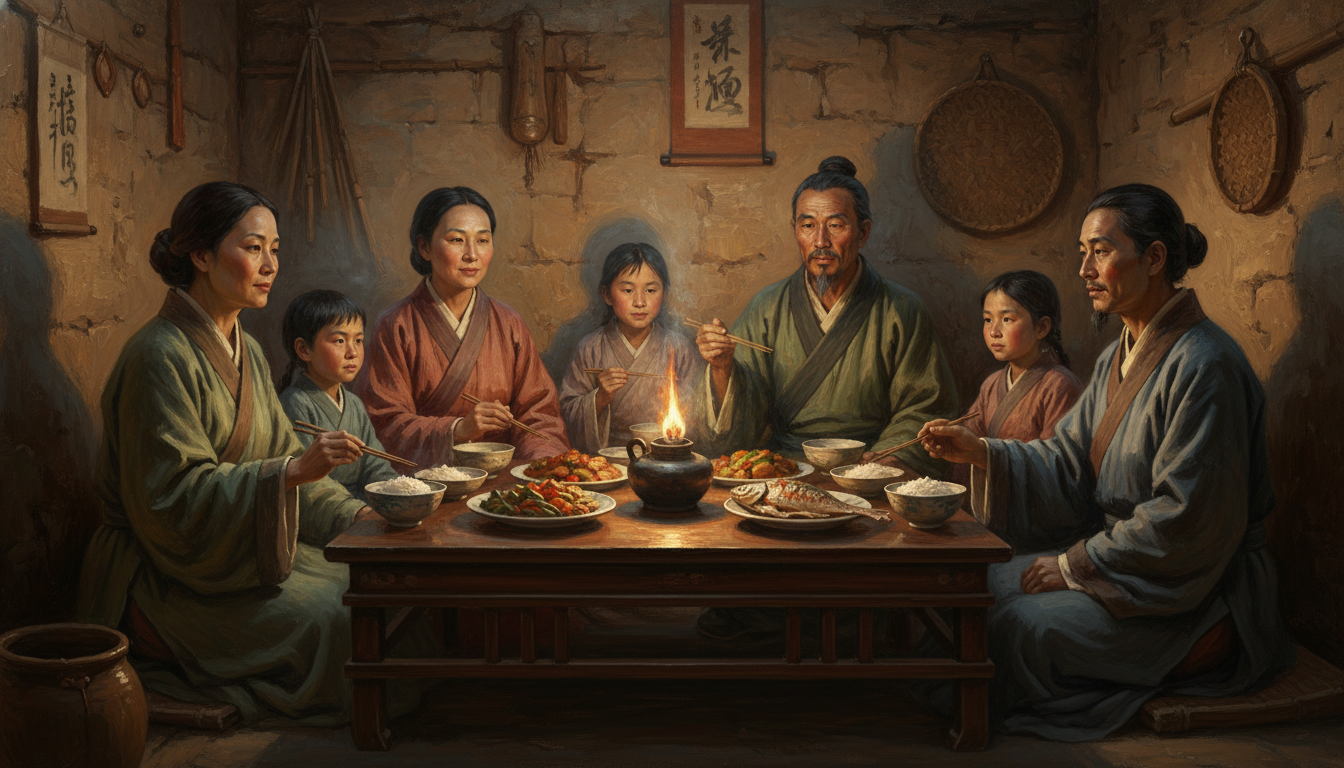
nned these interactions. The shared meal was not just sustenance; it was a daily communion, reinforcing familial bonds and the social order.
Children were taught proper etiquette—no talking with mouths full, offering the best portions to elders, respectful silence until addressed. The psychological weight of collective existence was palpable. Each member understood their role, their contribution to the family’s survival and prosperity. The night, for them, was a time of internal focus, a retreat from the external demands of the day, a chance to replenish not just their bodies but their spirits within the warm embrace of kin.
As the meal concluded, the sounds would shift again. The clinking of bowls gave way to the quiet rustle of straw mats being unrolled. The younger children, their bellies full, would often drift off to sleep almost immediately, their small forms nestled close to their parents or grandparents for warmth and comfort. Older family members might linger, perhaps patching a worn garment by the lamplight, or simply sitting in companionable silence, listening to the subtle symphony of the village settling down.
Outside, the croaking of frogs from the nearby paddy fields and the occasional distant howl of a jackal served as reminders of the wild world beyond the village’s protective embrace. The darkness was not just an absence of light; it was a presence, vast and ancient, a canvas upon which the intimate tableau of village life unfolded, illuminated by a handful of precious lamps and the enduring glow of familial warmth. This nightly ritual, repeated across countless generations, forged the very bedrock of ancient Asian society, preparing them for the dawn and the ceaseless cycle of life and labor.