The Venus Transit Enigma: Foresight of the Great Star
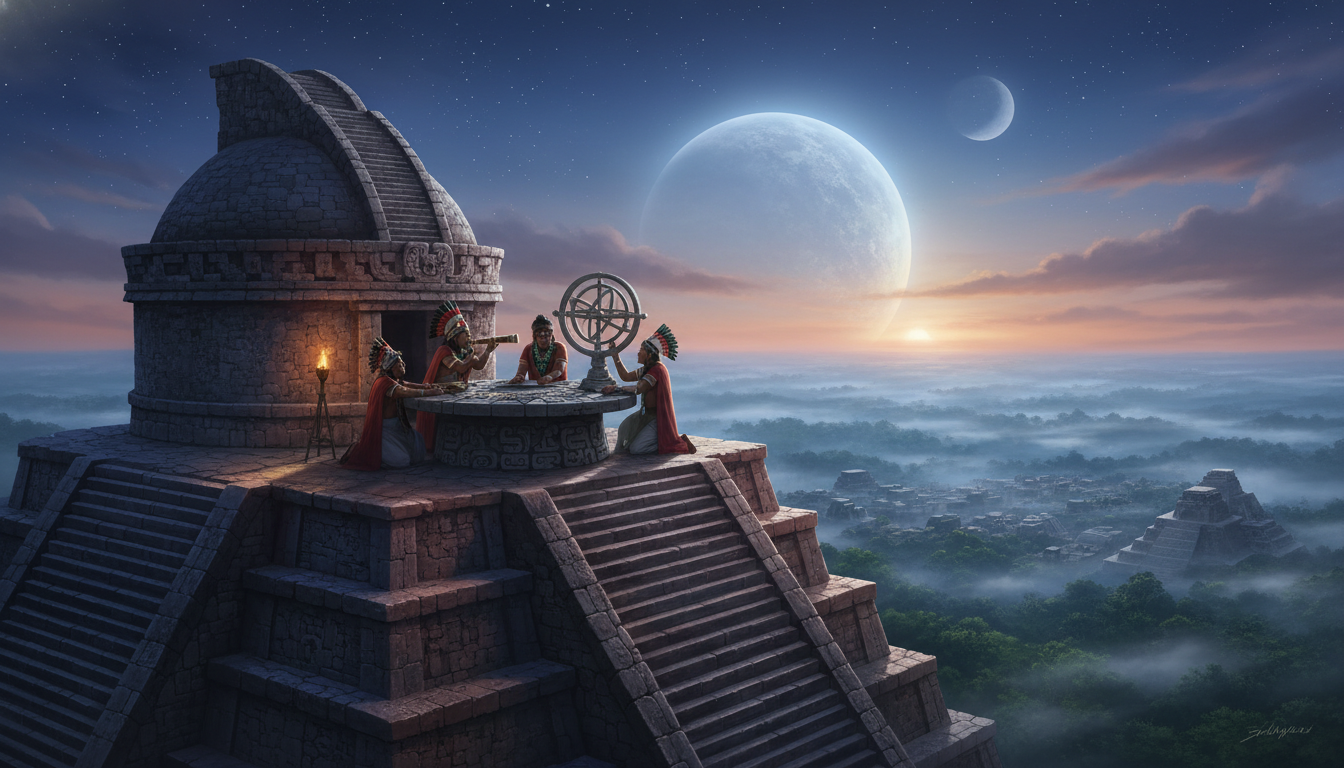
Among all the celestial bodies, none held greater sway over the Maya imagination and intellectual pursuit than the planet Venus. Known as ‘Chak Ek” or ‘Great Star,’ Venus was far more than a glittering point of light; it was a powerful deity, a harbinger of war, a guide for agricultural cycles, and a profound cosmic clock. The Maya meticulously tracked its movements, not just as the morning and evening star, but through its entire 584-day synodic cycle, understanding its intricate relationship with the solar year and its influence on earthly events.
Their obsession with Venus went beyond simple observation. They recognized that five Venus cycles (5 x 584 = 2920 days) align almost perfectly with eight solar years (8 x 365 = 2920 days). This precise congruence, which allowed them to synchronize their calendars and rituals, was just one layer of their profound understanding. What truly fascinates modern scientists is the possibility that the Maya were not only tracking the regular appearances of Venus but also had an awareness of its rarer, more elusive transits across the face of the sun. These transits occur in pairs separated by eight years, with intervals of over a century before the next pair.
While direct archaeological evidence explicitly detailing Venus transits is scarce, the extreme precision of their Venus tables in the Dresden Codex, and the deep significance they attributed to Venus’s movements over vast timescales, suggest an observational capacity beyond simple visibility. Some scholars hypothesize that their long-term, continuous astronomical records, passed down through generations, might have allowed them to predict these rare events, or at least understand their periodicity. Such predictions would have required an understanding of orbital mechanics and a commitment to data collection over centuries that is breathtaking to consider.
The Maya believed Venus’s position dictated auspicious times for significant events, from coronations to military campaigns. Its heliacal rise, in particular, after a period of invisibility, was seen as a moment of rebirth and renewed power. This wasn’t merely a spiritual belief; it was backed by generations of empirical data. The predictive power of their Venus tables demonstrates a scientific rigor that belies the common misconception of ancient peoples as solely mystical. They harnessed rigorous observation to understand the cosmos, and in doing so, they might have glimpsed phenomena, like the Venus transit, that remain challenging for modern scientists to confirm they truly understood with such limited technology. The deep astronomical insight of the Maya into Venus’s journey highlights a level of celestial foresight that continues to be a source of wonder and scientific inquiry.