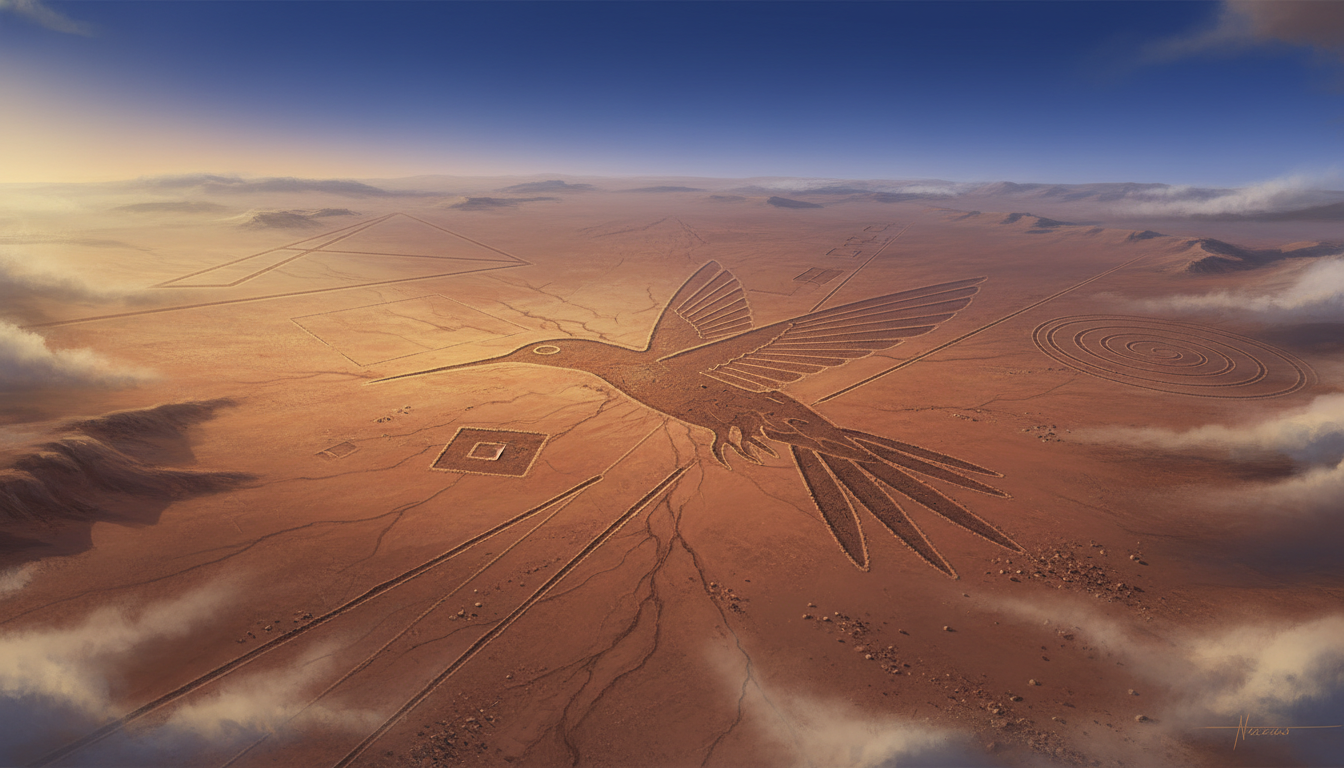
The vast, arid plateau of Nazca, Peru, stretches endlessly beneath a relentless sun. From the ground, it appears as an unremarkable expanse of reddish-brown earth and scattered rocks, unremarkable save for the occasional scrub brush battling for survival. But ascend into the sky, rise above the flat, unforgiving landscape, and the true marvel of Nazca reveals itself. Suddenly, the desert floor transforms into an enormous, intricate canvas, adorned with colossal geoglyphs carved with astonishing precision, some spanning hundreds of meters. For centuries, these silent behemoths lay hidden in plain sight, their meaning and purpose a profound secret whispered only by the winds.
It is believed the Nazca people, a civilization that flourished from approximately 200 BCE to 600 CE, created these magnificent works. Imagine a high priest, cloaked in intricately woven textiles, his face painted with ochre and indigo, standing on a makeshift scaffold, directing dozens of laborers. His arm sweeps across the horizon, indicating the next section of the vast hummingbird, its delicate beak pointed towards an unseen celestial alignment. The laborers, with crude but effective tools, meticulously remove the dark, oxidized stones from the desert surface, exposing the lighter soil beneath. They work with a methodical precision, guided by ropes, wooden stakes, and perhaps even rudimentary astronomical observations, ensuring that the lines remain perfectly straight, the curves impeccably smooth, even across undulating terrain.
The sheer scale of the undertaking is mind-boggling. How did they achieve such accuracy without the benefit of aerial perspective? Theories abound: observation platforms on nearby hills, intricate scale models, even hot air balloons (though this is largely debunked). The most plausible explanation points to advanced surveying techniques, possibly involving geometric principles and a profound understanding of perspective that allowed them to scale up smaller drawings to massive proportions while maintaining fidelity. The figures depict a bewildering array of subjects: geometric shapes—trapezoids, triangles, spirals—and biomorphs—a monkey with a spiraling tail, a spider, a condor, a pelican, a lizard, and, most famously, a hummingbird. Each seems to pulsate with a silent energy, a frozen testament to an ancient, unknown message.
For generations, these markings lay undisturbed, their significance fading into the mists of time, becoming mere curiosities or local legends. It wasn’t until the early 20th century, with the advent of flight, that their true grandeur became apparent. Pilot after pilot reported strange lines and figures on the desert floor, their reports fueling wonder and speculation. Maria Reiche, a German mathematician and archaeologist, dedicated over 50 years of her life to studying and preserving the lines, meticulously mapping them and theorizing about their purpose. She became known as the ‘Lady of the Lines,’ living a solitary life in the desert, consumed by the desire to unravel their mystery.
What compelled the Nazca people to invest such monumental effort? The secrets of their motivation are perhaps the most tantalizing aspect. Were they astronomical observatories, mapping celestial bodies and marking solstices or equinoxes? Many figures certainly align with significant astronomical events. Were they giant calendars, predicting planting and harvesting seasons in an unforgiving agricultural landscape? Or perhaps they were sacred pathways, processional routes for religious rituals, leading to specific altars or points of spiritual significance? Some propose they were offerings to sky gods, massive prayers etched into the earth, visible only to deities gazing down from above. Others suggest they were part of a complex water management system, guiding ancient aqueducts or marking underground water sources in a desert region where water was life itself.
The silence of the Nazca lines is deafening. They offer no written explanation, no accompanying tablets or stelae to illuminate their purpose. We are left to interpret, to hypothesize, to project our own questions onto their ancient forms. The figures stare back, timeless and inscrutable, holding their secrets tightly. They represent a lost knowledge, a lost language of meaning, a window into a worldview that is now utterly foreign to us. The Nazca civilization, like the desert itself, eventually faded, leaving behind only these magnificent, perplexing drawings—a monumental secret etched into the earth, challenging us to look beyond the obvious and contemplate the profound mysteries of human intention and ingenuity across millennia.