The year is 48 BCE. Alexandria, jewel of the ancient world, gleams under the Mediterranean sun. Its heart beats in the rhythmic hum of the Great Library, a monumental edifice of human ambition and intellect. Within its hallowed halls, sunlight filters through high windows, illuminating dust motes dancing above towering papyrus scrolls. Thousands upon thousands, perhaps even a million, meticulously copied texts line shelves stretching into the architectural distance, each a vessel for a voice from the past, a scientific discovery, a philosophical treatise, or a poetic masterpiece.
Demetrius, a head librarian whose brow was perpetually furrowed with the weight of knowledge, moved through the aisles with a reverence bordering on religious awe. He ran a calloused hand over the brittle parchment of a Homeric commentary, its ink faded but its wisdom eternal. He felt a deep connection to every scholar, every scribe who had ever contributed to this immense reservoir of human understanding. The air itself seemed to vibrate with the silent conversations of countless minds. The Library was not merely a collection; it was a living organism, absorbing, preserving, and disseminating the very essence of civilization.
But a shadow loomed. Julius Caesar, entangled in the Alexandrian War, found himself besieged. As his fleet faced destruction in the harbor, he made a desperate, fateful decision: to set fire to the Egyptian ships. The winds, however, had other plans. A sudden, violent gust swept the flames from the docks, an inferno unleashed upon the unsuspecting city. Panic erupted. Shouts turned to screams as the fire, a ravenous beast, began its terrifying march inland, consuming everything in its path.
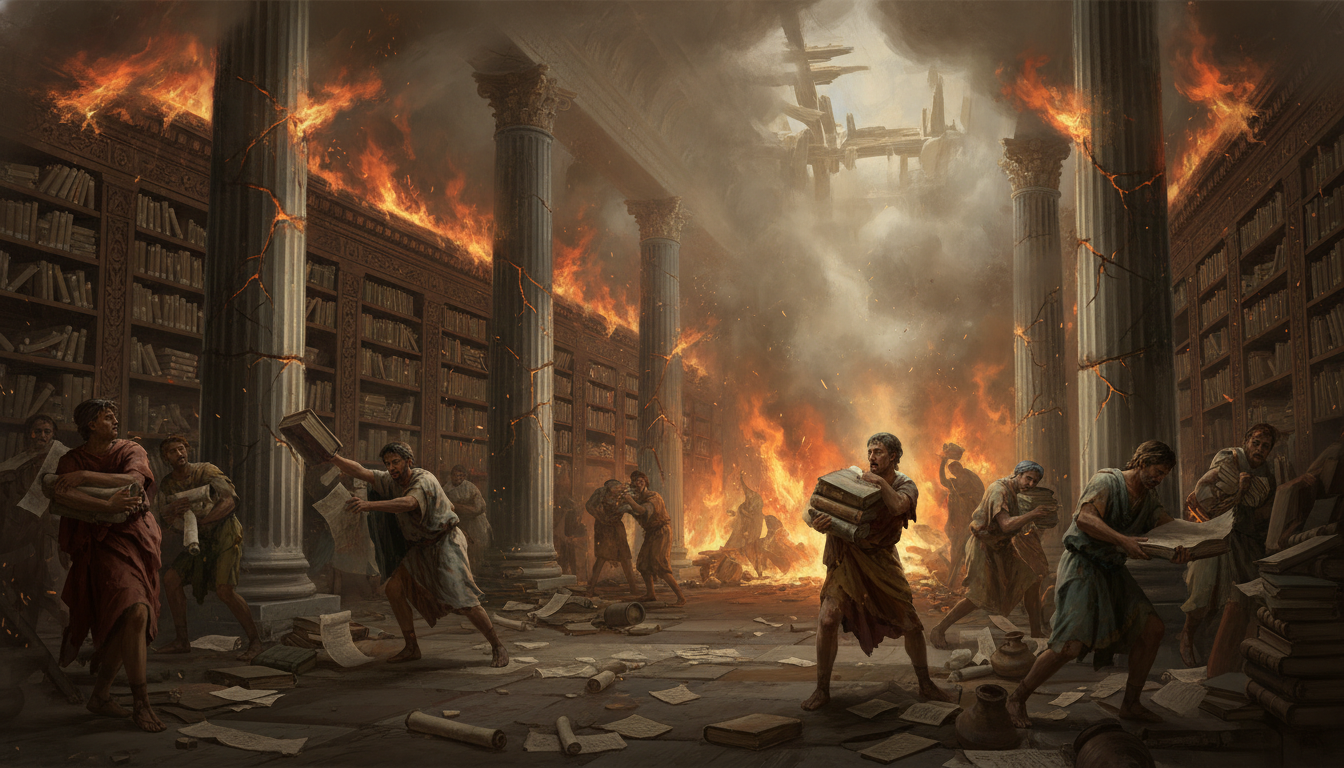
Demetrius, alerted by the distant roar and the acrid smell of smoke, watched in horror from the library’s portico as a pillar of black smoke choked the azure sky. His heart pounded with a terrible dread. This was not merely a fire; it was an existential threat. He rallied his staff, their faces etched with terror and disbelief. “Quickly!” he commanded, his voice raw. “To the scrolls! Save what you can!” But the sheer volume was insurmountable. Even as they formed desperate lines, passing precious bundles from hand to hand, the fire advanced with terrifying speed.
Flames licked at the marble facade, then devoured the wooden doors. The intense heat buckled shelves, sending scrolls cascading to the floor, where they instantly ignited, their words turning to ash. The crackling roar of the fire drowned out the cries of despair. Demetrius saw a young scribe, tears streaming down his face, clutching a single, half-burned roll as if it were his own child. The air grew thick with smoke, choking and blinding, forcing them to retreat, their efforts futile against such an elemental fury.
Years, perhaps centuries, of irreplaceable knowledge vanished in mere hours. Euclid’s original geometrical treatises, Sappho’s complete lyrical poems, the lost plays of Aeschylus, historical accounts detailing forgotten empires, astronomical observations that mapped stars with an ancient precision—all reduced to cinders. The exact extent of the destruction remains debated by historians, but the consensus is clear: a monumental loss occurred. It wasn’t just the physical texts; it was the entire intellectual lineage, the threads of thought and discovery, that were severed.
Demetrius, collapsing outside the burning building, coughed racked his body. He watched, helpless, as the monumental structure glowed like a funerary pyre against the deepening twilight. The acrid smell of burning papyrus clung to his clothes, a scent that would forever haunt him. He thought of the laughter of scholars, the excited whispers of discovery, the quiet rustle of turning pages—all now silenced, perhaps forever. The secrets contained within those scrolls, the answers to questions we can only now imagine, became ashes, scattering on the winds of history.
The fire in Alexandria wasn’t a single catastrophic event but a symbolic moment in a protracted decline. While some argue that only a warehouse was lost, or that subsequent destructions by Roman emperors, Christian mobs, and later, the Muslim conquest, further contributed to its demise, the emotional weight of that initial blaze cast a long shadow. The burning represented a turning point, a profound rupture in humanity’s intellectual continuity. It left an unfillable void, an echo of forgotten knowledge that continues to resonate through the centuries, a permanent secret buried beneath the silence of lost wisdom. The whispers of what *could have been* still haunt the imagination, a ghost in the annals of human endeavor, reminding us of the fragility of our collective memory and the irreversible nature of profound loss.